Written by Leo Liang · Last reviewed 2026
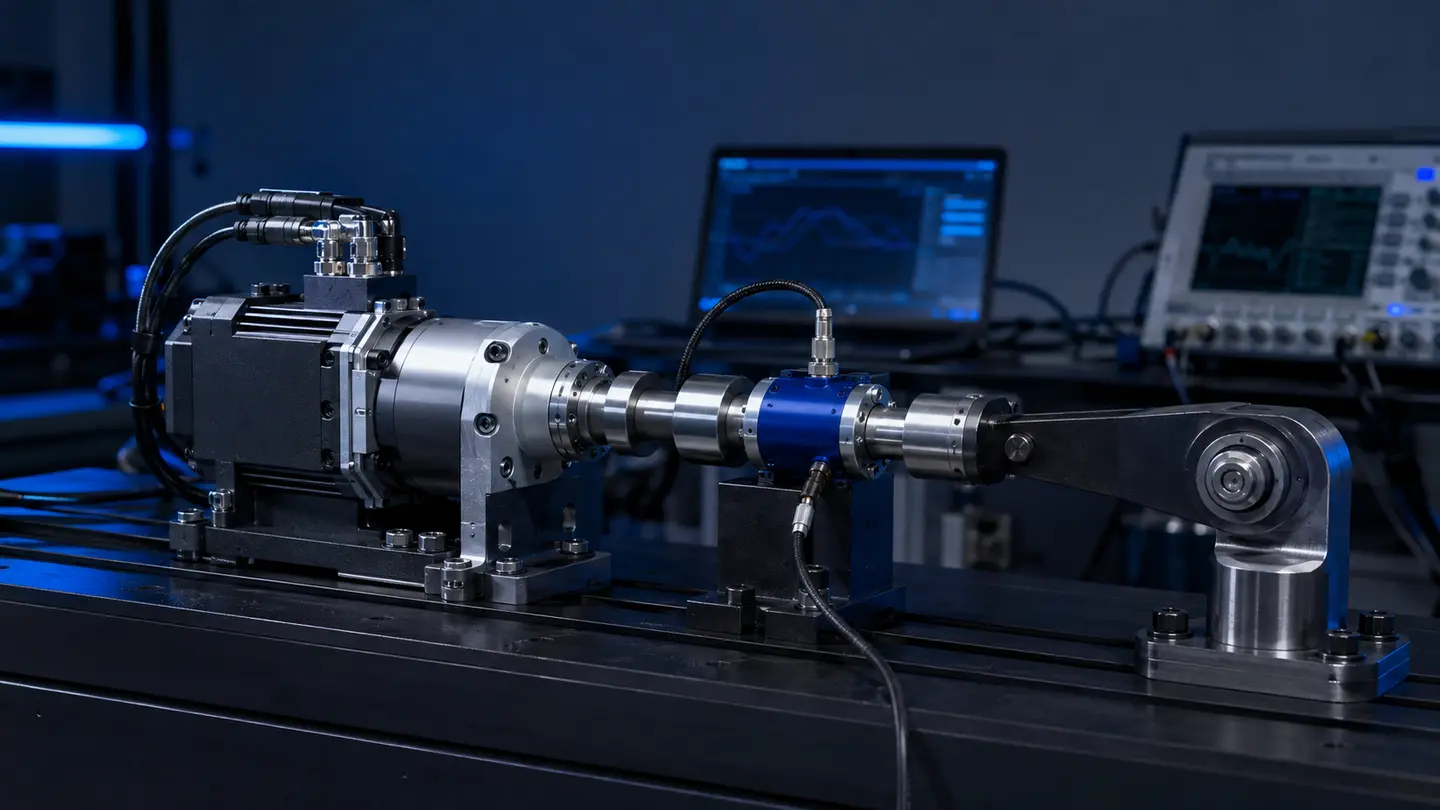
Almost every robotics team that sources its first actuator batch from China gets caught by the same thing. The datasheet says 40 Nm. The part arrives, goes into the leg, and the robot walks for twenty minutes before the joint thermally throttles or the driver faults out.
Nothing was misrepresented. The 40 Nm was real. It was just peak torque, measured for a few seconds into a motor at room temperature with no load history, and it is not the number your thermal design has to survive.
Why the two numbers diverge so much
Torque in a brushless motor is roughly proportional to current, and heat rises with the square of current. An actuator that can produce 40 Nm briefly might only sustain 12 to 15 Nm indefinitely, because at the higher figure the windings reach their temperature limit in under a minute. The ratio between peak and continuous is typically somewhere between two and three to one, but it depends entirely on the thermal path out of the motor.
That thermal path is the part nobody documents. The same actuator bolted to a large aluminium structure behaves very differently from one hanging in free air. This is why a continuous rating quoted without its test conditions is close to meaningless.
What Chinese datasheets typically show
In our experience the pattern is consistent enough to plan around:
- The large number on the front page is peak, whether or not it is labelled as such
- Continuous is often present but in a table further in, sometimes only in the Chinese version of the document
- Test conditions for either figure are usually absent
- Where a duration is given for peak, it is commonly one to three seconds
- Ambient temperature, if stated at all, is 25 degrees C with no forced cooling
None of this is unique to Chinese suppliers. Western manufacturers do the same thing with a more polished document. The difference is that a Western distributor will usually give you the application engineering on request, and a small factory selling twelve units will not.
The four questions that get you a usable answer
Send these verbatim, in writing, and ask for the answers in writing. A supplier who will answer them is worth more than one who is ten percent cheaper.
- What is the continuous torque at 25 degrees C ambient, and what heatsinking was used during the test? If the answer is “no heatsink, free air”, the number is conservative and useful. If the answer is a large aluminium fixture, derate it for your structure.
- What is the winding temperature limit, and what protection triggers first? This tells you whether the actuator degrades gracefully or faults out mid-motion, which matters a great deal for a legged robot.
- For how many seconds can peak torque be held, and what is the required cool-down before it can be repeated? Duty cycle is the real constraint on a walking gait.
- Can you send the raw test data or a thermal curve rather than the summary figures? Roughly half of suppliers will. That half is a useful filter on its own.
A practical rule of thumb
Until you have measured the part yourself, design against 70 percent of the stated continuous figure, and treat peak as available only for transients you can count. This is conservative and it will cost you some mass and some money. It is considerably cheaper than a redesign after the first walking test.
What we do about it
We ask those four questions on every actuator line before we send you a quote, and the answers go into the quote alongside the price. Where a supplier will not answer, we say so, because that refusal is a data point about how the relationship will go once you have paid a deposit.
Working on something in this area? Send us the BOM line and we will quote it. No obligation, and we will tell you if you should buy it locally instead.
Send one line and see what comes back.
You do not need a finished BOM to start. Send the single part that is currently blocking you and we will quote it. It costs you an email and tells you more about us than this page can.